We were told to do a research on art movement and to check out the list of art movement that are available. Photography & typography are off limits. So I checked everything out and I got attracted to Surrealism & Lowbrow.
Art Movement became a trend to those who shared the same passion towards art and turned it into a culture and also a form of celebration by displaying their artwork on a certain period of time, like boxing day or valentines day. Its like a fashion trend where it changes throughout through time and most people follows it due to pop culture, like an evolution.
Surrealism
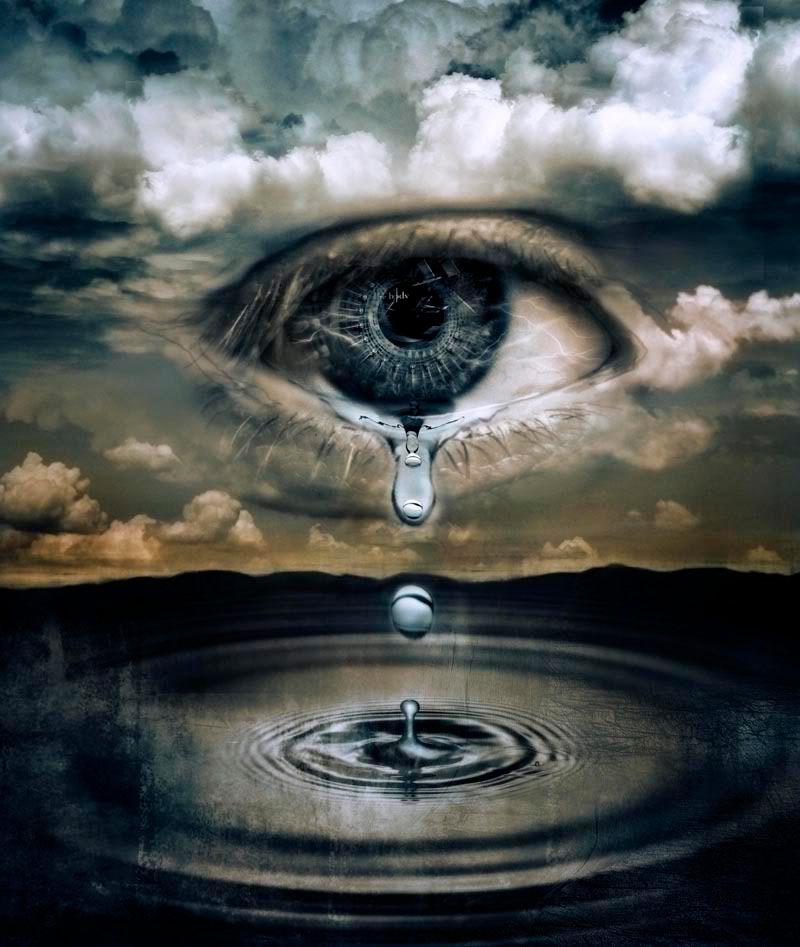
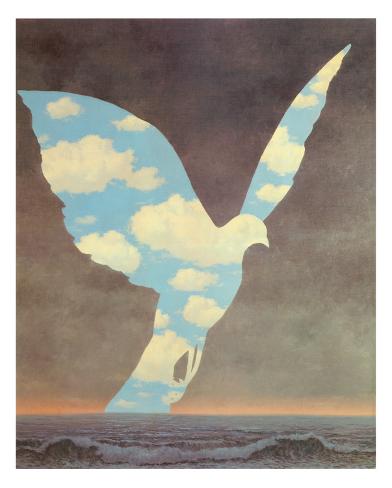
Depression, 2007 by Optiknerve | Le Grande Famille, 1963 by René Magritte

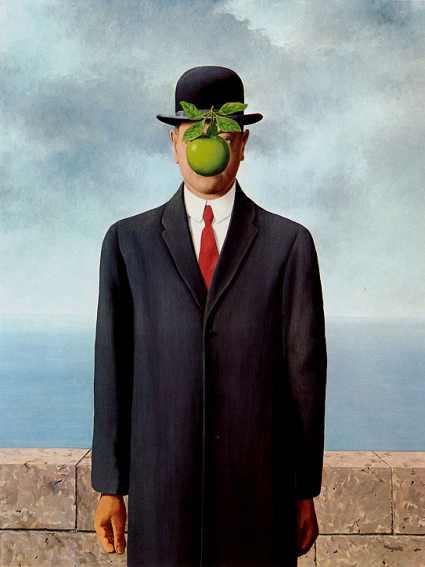
Mermale 002, 2008 by Optiknerve | Son of Man, 1964 by René Magritte


Legendary Castle, 2010 by Paul Fleet | Facade and Masquerade, 2008 by Daniel Chiriac
I love how surrealism tickles my mind, I get very intrigued when I look at the pictures.
Surrealism movement reflects the changing philosophies of the early 20th century. Great philosophers, politicians, artists and musicians were questioning the prevalent traditions in each field, with many rebelling against what had been time-honored and often restrictive methods. Inspired by the Dada movement, which emerged after World War I as an anti-establishment philosophy, Surrealist artists sought to tap into the unconscious and whatever lay beyond-whether ugly or beautiful, horrific or inspiring.
Its nature is undetermined as it is a widespread movement, to have members from that of artists, poets, writers and even politicians. The state of it being non reality mixed with imagination whilst then stirred with dreams made it a strong conviction to be of inspiration for many.
The Founder
Andre Breton was the leader of the Surrealist movement in Paris in the early 1920s. Breton had been exposed to the horrors of World War I as a doctor and identified with the Dadaist anti-war and anti-government philosophies. Around the same time, exploration into the human mind expanded the role of psychology, with Sigmund Freud and Carl Jung publishing works on the unconscious mind and all its secrets. Breton formed a society of Surrealists, who were dedicating their talents to create modern art that furthered the movement.
Surrealist Art
Sculpture and paintings of the time reflected the artists' desire to examine the human mind through imagery, symbolism and dreams. Characteristics of surreal art include normal objects in unusual places, dreamlike scenery, mythical or impossible creatures, juxtaposed items and out-of-place objects. Many artists sketched using a stream of consciousness-doing whatever came to them as they cleared their minds. Still others attempted to reveal both the good and bad of the human psyche, with both dream and nightmare sequences captured as art.
Artists Of The Day
The most prolific of the Surrealist artists joined Breton in Paris and began producing art that reflected the basics of the Surrealist philosophies. Salvador Dali, a Spanish painter, produced some of the most recognizable paintings, including "The Persistence of Memory," "Swans Reflecting Elephants" and "Galatea of the Spheres." Rene Magritte also emerged as a Surrealist master, with "The Treachery of Images," "The Son of Man" and "The Listening Room." Other artists involved in the movement included Marcel Duchamp, Max Ernst, Joan Miro and Man Ray.
During the art movement of Surrealism, paintings depicted the unconscious mind and dreamlike alternate realities for study and inspiration. The Surrealist movement emerged in the 1920s in Europe and allowed artists to push beyond traditional painting techniques, methods and philosophies. Until the 20th century, paintings tried to capture reality, but the more modern movements attempted to change what seemed real and gave viewers a glimpse beyond reality.
Out-Of-Place Objects
Most Surrealist artwork used realistic-looking items but placed them in a strange or unusual context. An example of this is the Rene Magritte painting "Son of Man," where a well-dressed man stands stiffly with an apple for a face. Another of his paintings, "Time Transfixed," shows a locomotive coming out of a plain fireplace. Magritte's "The Portrait" reveals a realistic table setting that appears normal, except for the single eye in the center of the entrée.
Unreal Scenes
In Surrealism, people and animals often appear in seemingly normal settings, but, upon closer inspection, the settings are anything but ordinary. In "Metaphysical Interior With Biscuits" by Giorgio de Chirico, a room full of clutter becomes a Surrealist landscape. In "The Listening Room," Magritte painted a brightly lit room and an apple-not uncommon subjects for painting. However, the green apple fills the entire room from wall to wall.
Normal Objects Acting Abnormally
Surrealist paintings often took everyday objects that performed outside their normal function. In Salvador Dali's "The Persistence of Memory," clocks and pocket watches melt all over a barren landscape. Magritte's "Not to Be Reproduced" features a man looking into a mirror, but the back of his head is reflected there, not his face.
Fantastic Creatures
Surrealism also conjured impossible creatures to populate the canvas. Good examples of this include Dali's "Shirley Temple, The Youngest, Most Sacred Monster of the Cinema in Her Time," where the head of the young movie star is placed on the body of a breasted feline body. Another example is Max Ernst's "The Elephant Celebes," which features a large mechanical elephant and a nude, headless human body.
René Magritte
He was then a child born on 21st November 1898, Magritte is now a well known artist. Famous for his witty, thought provoking, and in depth images, he is a man who challenges the observers preconditioned perceptions of reality.
Born in a middle class family, Magritte however, had to go through childhood seeing the his own mother repeatedly trying to kill herself. In which it had availed and thus many critics is of the opinion that his works is the product of such tragedy.
Magritte was like most artist, he began to draw at a young age then thus slowly flourish. He learned and schooled all over Belgium where he collected repertoire of skills and styles of painting. His first of his mastered creations was that of female nudes.
The first career that he had was that of a mere painter, however, this began to translate to advertising as his skill risen and his projects famed. He then created an advertising company with his brother. It was during this time he had befriended members of the surrealist movement.
Whilst his worked moved towards surrealist paintings, he kept his style of painting with varieties of colors. Belgium then occupied by Germany, Magritte had ventured into forgeries of currency to sustain himself and those of his family.
When death had taken his life on 15th August 1967, Magritte had accomplish the height of which his works was known for their of special blend of personal indignation and preconditioned perception challenges.
DEPRESSION
Elements of Design
Lines : Wispy lines, strong lines, soft lines are used to create this art.
Shape : The eyes are the positive shape in this art however because of the background in the art depicts sadness, thus the eyes gives a negative feeling.
Values : The tone in this art is sad and depressing.
Colours : The colours used have different hues to the art. Moody.
Texture : It's smooth and dream-like.
Alignment & Proportion : There are different proportion of the artwork. Eyes are biggest and the main focus of the art.
Principles of Design
Hierarchy : The art focuses on the crying eye then followed by the cloudy background.
Balance : The balance of this art is proportioned. Meaning, the lightness of the clouds contrasts nicely with the darkness of the hills to create depths.
Proximity : The proximity exists in the clouds and the water ripple.
Rhythm/Repetition : The repetition of the soft lines in the clouds and the strong lines used to create the ripple and the strong repeated strokes to create the details of the pupil.
Scale : The scale is dream-like and surreal.
Emphasis & Variety : The emphasis is mainly on the eye and the tear drop.
Harmony & Unity : The colours are harmoniously blended together. However, there are no pastel colours in the art, only dark hues used.
Lowbrow


Speedy, 2011 by Scott Scheidly | There in Time, 2008 by Brandi Milne


Birth, 2011 by Scott Scheidly | Dogan & Pogan, 2009 by Brandi Milne

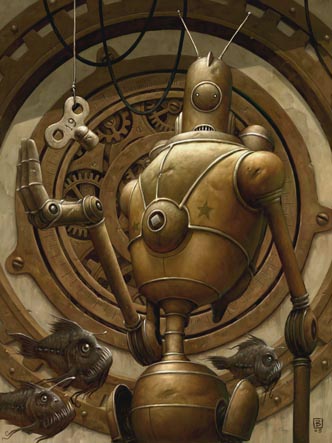
Happy World by Yoko d'Holbachie | Piscis Ex Machina by Brian Despain
The reason why I picked Lowbrow because it somewhat describes my imagination.
It started in the late 1970's as an underground visual art movement. It is an art form that depicts a sense of humor that sometimes is that of sarcasm. Better known as pop surrealism, it has influenced many creations and artists to look through its distinct styles and is thus the center subject for many magazines.
It is an American art movement that is gaining momentum in big cities worldwide. Surged in 1994 by artist Robert Williams, it includes a wide range of styles and subjects, from decal art to velvet paintings and tatoo flashes to intensely detailed paintings of fantastic scenes. Favorite subjects include "B" movies and sci-fi, late sixties San Francisco comix, early sixties auto accessories art and car monsters, early pinup (soft core erotica), cartoons, japanese animation, current and retro tattoo imagery, violent/sadomasochistic images and even clowns painted by serial murderers.
Lowbrow art, when professionally presented, is now attracting big collectors and high gallery prices.
Lowbrow was born of underground or "street" culture.
The single most common tactic that Lowbrow artists employ is to poke fun at convention. They know the "rules" of art, and consciously choose not to abide by them. Lowbrow art has a sense of humor. Sometimes the humor is gleeful, sometimes it's impish and sometimes it's born of sarcastic comment, but it is always present. Lowbrow draws heavily on icons of popular culture, particularly those now commonly known as "Retro". Tail-end "Baby Boomers" will recognize them straight away.
Lowbrow, while it is defining itself, goes by a number of aliases: underground, visionary, Neo-Pop, anti-establishment and "Kustom" are but several examples. Additionally, John Seabrook has coined the phrase "Nobrow", and one has also seen the term "Newbrow".
For the time being, most Lowbrow art isn't sanctioned by the critical/curatorial/gallery-going mainstream. Exceptions to this seem to be happening primarily in Los Angeles, San Francisco, New York, Atlanta, Paris, London and Tokyo. In 2005, many major cities have opened lowbrow galleries, and tourist hotspots have discovered this cutting edge subculture. Juxtapoz magazine is the best bet for becoming acquainted with Lowbrow artists.
Lowbrow currently suffers something of an identity crisis, due to having a wide variety of artists lumped into it. For example, the designer of a simple, kitschy decal may be accorded the same Lowbrow designation as the artist who composes a technically masterful Lowbrow painting or sci-fi sculpture. Hopefully, this will sort itself out in years to come. Meanwhile, you might want to begin collecting Lowbrow now, paying attention to signed limited editions and professional presentations. Lowbrow artworks comes in various form, it could be a painting but in the form of toy, digital art and also sculpture. The more outrageous stuff may fade, but Lowbrow as a category appears to have a very bright future.
SPEEDY
Elements of Design
Lines : Bold, strong dark lines are used to create the mushroom and the background.
Shape : The shape creates the mushroom in a positive way. The lines used are detailed and shows that it clearly is a mushroom.
Values : The tone of this artwork is fast and dangerous.
Colours : The colours are dirty and muddy. Dark.
Texture : The texture of the artwork looks grainy and smokey.
Alignment & Proportion : The alignment shows that is it zoomed into the mushroom, because of this the proportion of the art is realistic.
Principles of Design
Hierarchy : The artwork shows the mushroom zooming away.
Balance : The balance is good depicts in the real world perception.
Proximity : There are not much proximity in the artwork.
Rhythm/Repetition : It is clear that there is repetition in the star.
Scale : The scale of the artwork is also dream-like because there are no such thing as a mushroom sprouting fire.
Emphasis & Variety : The mushroom is the main emphasis of the artwork.
Harmony & Unity : Everything is unified, the details of the mushroom is detail like the real mushroom.
Theme : Family, Hopes & Dreams
